Cruise the stunning Alaskan Glaciers with Seabourn.
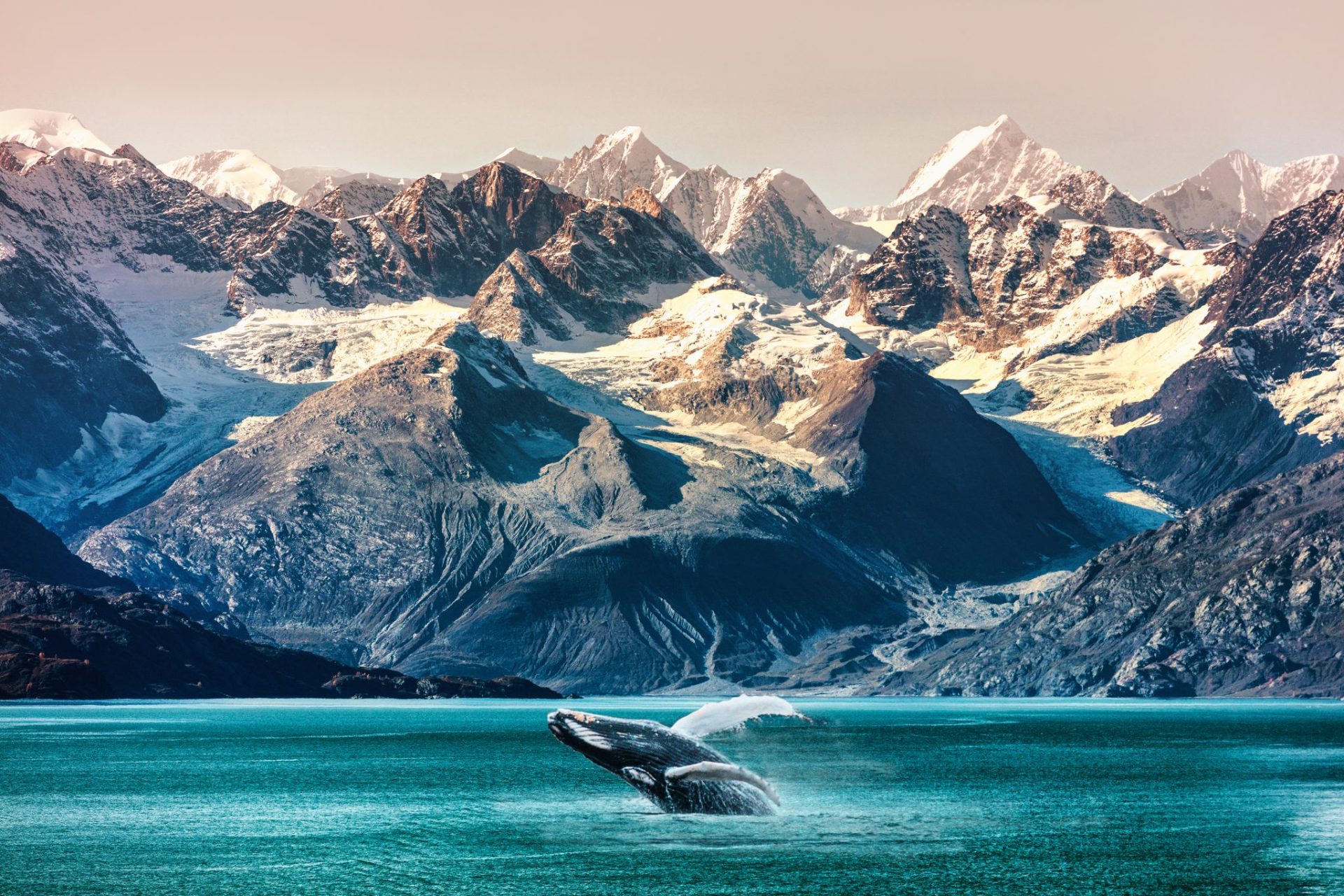
Alaska will make you feel alive, as we see, hear, touch and smell one of the last frontiers. Here, the wilderness seems to stretch out forever. The majesty of the snow-covered peaks and glaciers combined with the history of the towns and the wildlife will leave you in awe.
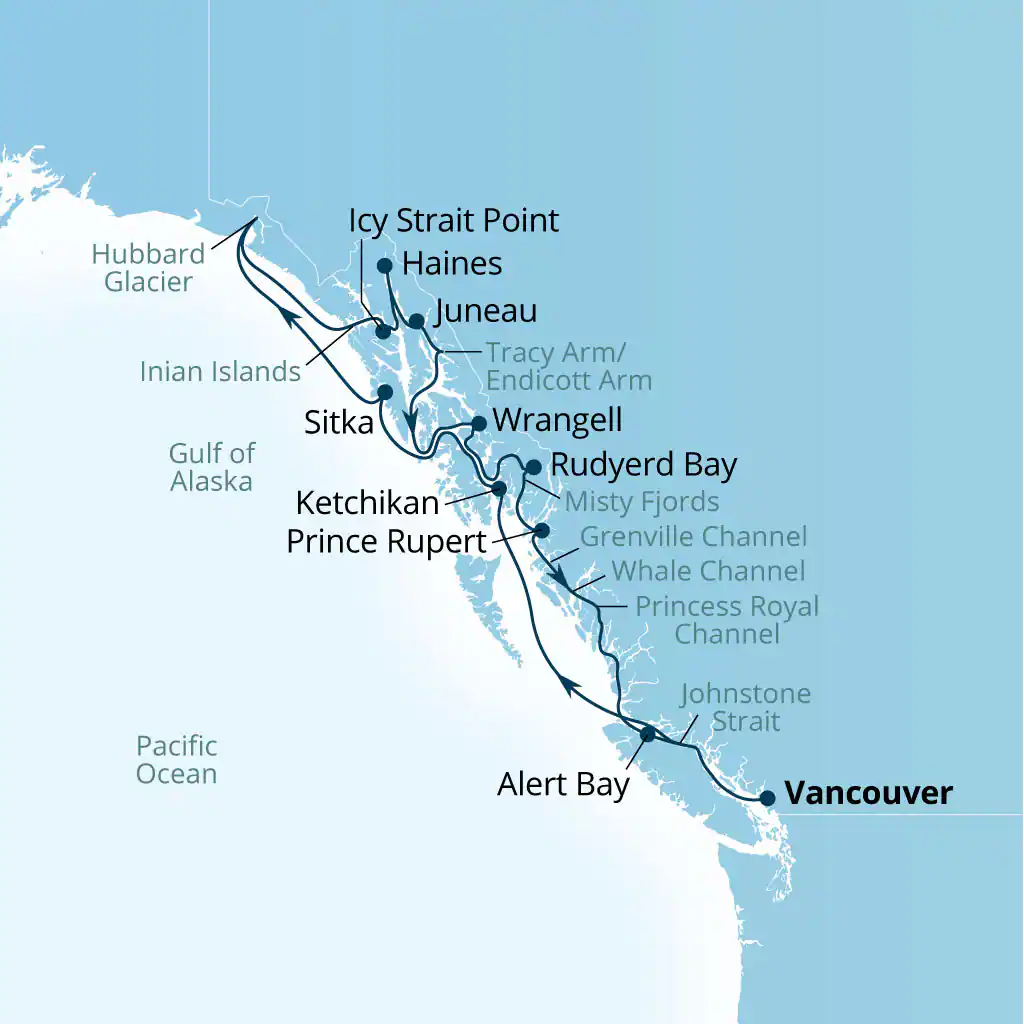
Seabourn Encore – 14-night Alaska Glaciers & Inside Passage
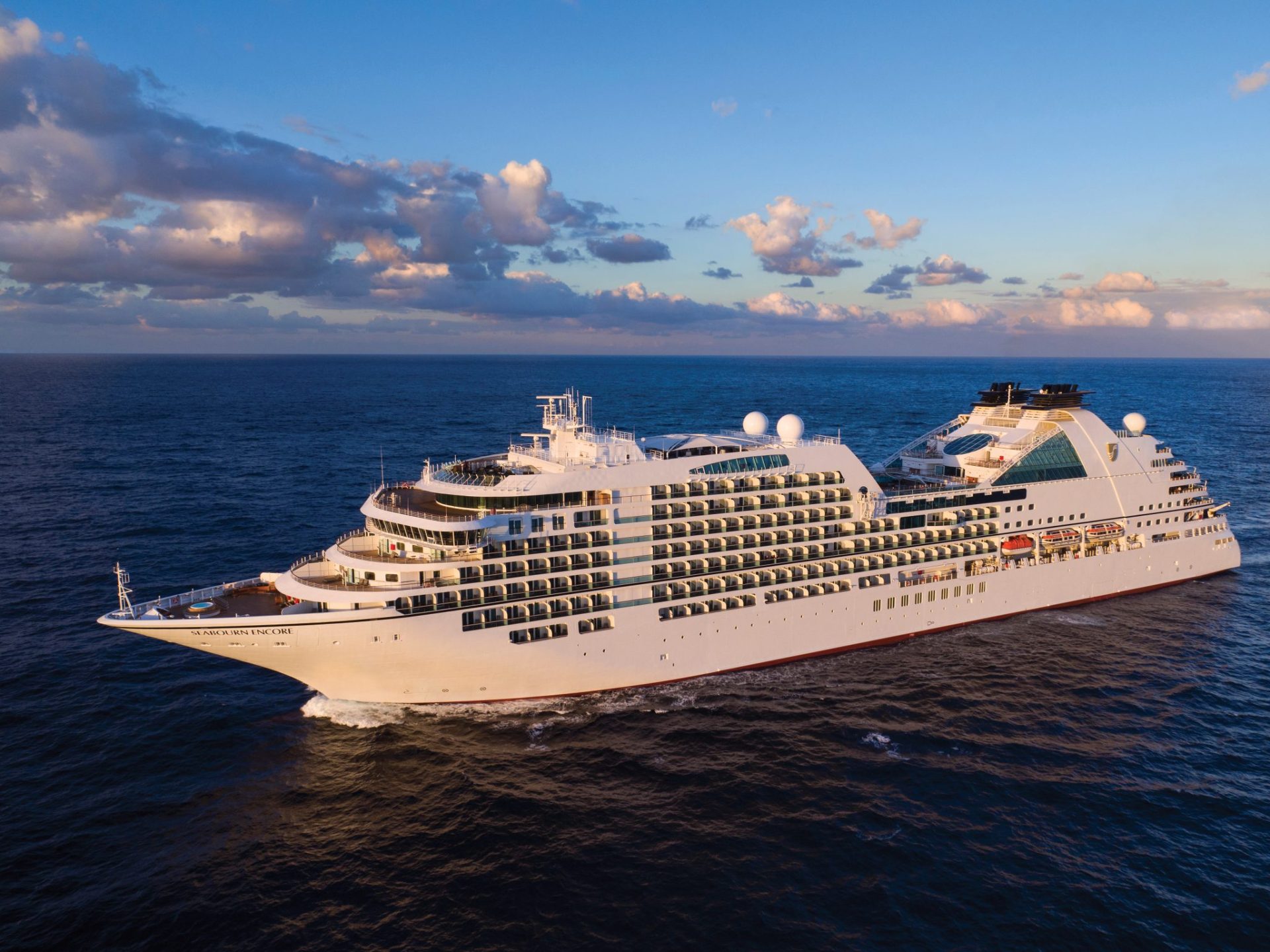
We join our superb cruise ship for the 14-night cruise from Vancouver. This 604-guest ship is fully inclusive onboard, and with their unmatched sense of style, elegance and grace, Seabourn Encore beckons you to travel on what is an ultraluxury resort at sea. Let’s not forget of course the magnificent passing scenery and interesting and exciting ports of call.
Highlights
- Vancouver
- Ketchikan
- Hubbard Glacier
- Sitka
- Tracey Arm
- Wrangell
- Prince Rupert
Tour Itinerary
Vancouver is a city blessed with unparalleled natural beauty. Surrounded by mountains and water, the cityscape is a stunning juxtaposition of modern architecture against a backdrop of majestic peaks and the Pacific Ocean. Stanley Park, an urban oasis, offers a haven of lush forests, seawalls, and beaches, providing a perfect escape into nature without leaving the city. From skiing and snowboarding in the nearby mountains during the winter to hiking, biking, and kayaking in the warmer months, outdoor enthusiasts will find a paradise here. Grouse Mountain, a short drive from downtown, transforms into a winter wonderland, and the extensive network of trails in and around the city provides endless opportunities for exploration. Vancouver’s multicultural population has resulted in a rich tapestry of cultures and cuisines. The city’s diverse neighborhoods showcase a vibrant mix of art, music, and culinary experiences. Food lovers can indulge in a world of flavors, from Asian street food to Pacific Northwest seafood, making Vancouver a true epicenter of cultural fusion and gastronomic delights.
We depart at 5pm
The Queen Charlotte Sound lies between the Queen Charlotte Strait, which winds between Vancouver Island and the British Columbia mainland in the south, and Hecate Strait, which is northward, adjacent to the Haida Gwaii Islands off the Pacific coast of British Columbia. It is a broad reach in the long shipping route called the Inside Passage threading the myriad islands stretching from Washington’s Puget Sound to Alaska.
Ketchikan is a picturesque coastal town with a colorful frontier history, standing at the southern entrance to Alaska’s famed Inside Passage. It began as a salmon cannery in 1885, built by company employee Mike Martin at the mouth of Ketchikan Creek. Once dubbed the ‘Canned Salmon Capital of the World,’ today government, commercial fishing, and tourism are its main industries. The renowned Creek Street, perched on stilts along the mouth of the creek, would bring lasting infamy to the area for the red-light district that burgeoned there during the Gold Rush.
The town’s site first served as a camp for Tlingit people, and for thousands of years this has been their home. Their rich culture is being preserved to this day. A visit to Ketchikan is not complete without visiting one or all of Native American sites such as Totem Bight State Park, Potlatch Park, Saxman Native Village and the Totem Heritage Center. Together, these locations comprise the world’s largest collection of standing Native American totem poles.
Arrive 7am
Depart 3pm
Story and soul await in the history and lush scenery of this remote city on Baranof Island. As the oldest city in Alaska, only accessible by air and sea, Sitka is the perfect place to relish in unbridled beauty of the Last Frontier. Nicknamed the “Paris of the Pacific” for the growing wealth acquired during its logging, gold, and fur trade booms, Sitka was sold to the United States by Russia in 1867. Picturesque remnants of Russia’s architectural influence are still present; one of the most intriguing structures is the Cathedral of Saint Michael, built in 1848 to honor a Russian Orthodox bishop. The mix of Tlingit tradition runs heavily through Sitka’s streets as well, making for a unique blend of history and culture. From salmon fishing, hikes in the Tongass rainforest, exploring the coastline by private vessel, or even a round of golf in some of the toughest and most beautiful holes in all of Alaska… one visit to Sitka is never enough because of the infinite ways to connect with its culture, wildlife, and people.
Arrive 8am
Depart 5pm
Yakutat Bay is 18 miles wide at its entry, and cuts from the Gulf of Alaska into Disenchantment Bay, the entryway to the huge Hubbard Glacier, North America’s largest tidewater glacier. As the bay narrows and the shorelines draw closer, the 400-foot face of the glacier exerts a luminous, ghostly presence, often from as much as 30 miles away. More and more floating ice dimples the surface of the water, and seals bob up and disappear again. The chilled air from the glacier flows in a downdraft of cold that gives rise to mists and gray clouds, through which the vivid blue of the ice wall shimmers. It is an impressive sight of nature’s immense raw workplace, shaping the earth itself as part of an endless cycle of water from the sea evaporating to the sky, falling as snow on the heights and inching over centuries back again to the sea.
As the gatekeepers to the northern entrance of the fabled Inside Passage, the remote Inian Islands stand between Cross Sound and Icy Strait, exposed to the high energy seas of the Pacific Ocean. Tidal currents surging through the narrow channels separating the islands can be severe. Nicknames like ‘The Laundry Chute’ justify their notorious reputations.
For millennia, Tlingit people came here to hunt and fish in the rich bounty that these waters provided. Today, the Inian Islands Institute, located within the islands, provides access to the abundant and protected waters for scientific research. Sitka black-tailed deer and brown bears frequent their rugged and rocky shores, while sea lions fill their stomachs with salmon before hauling out to rest on the many rocky outcrops making up this island group. Sea otters, bald eagles, and humpback whales frequent the area in great numbers during the summer months.
The Inian Islands were named by William Healey Dall, one of Alaska’s earliest scientific explorers, in 1879.
Arrive 5:30am
Departs 12:30pm
Icy Strait Point is a unique community on Chichagof Island near the entry to Glacier Bay National Park. It was created and is owned by a corporation of over 1300 Native Americans of various local Tlingit tribes, for the purpose of offering visitors an enjoyable, educational experience of Alaska’s native cultures, as well as the human and natural history of the region. Your tender will dock at the historic 1912 salmon canning facility, which today is a museum. The surrounding grounds offer cultural performances, Native American-owned shops and galleries, restaurants and a variety of tours and excursions for every interest from sport fishing to whale watching, guided nature walks and excursions to view bears and other wildlife, ATV tours and even a zipline adventure that is said to be the longest (over a mile) and highest (over 1330 feet of drop) in North America. The small village of Hoonah is just over a mile away, and can be reached either by walking or on a shuttle. It also has shops and eateries, as well as a totem-carving enterprise run by the corporation. The Huna Totem Corporation maintains complete control of the content and access to the community, which has won a number of prestigious awards for its sustainable approach to exploiting the natural and historical heritage of Alaska and its native peoples for their benefit.
Arrives 4pm
Departs 8pm
Tucked in along the shores of the longest fjord in North America and surrounded by breathtaking scenery, Haines is an authentic Alaskan experience. It is an eclectic community and a truly hidden gem. Its rich culture shines brightly during the annual state fair that draws people from all over Alaska.
Haines is home to the largest concentration of bald eagles on earth, and grizzly bears gorge themselves on spawning salmon in its rivers. It was originally named Dteshuh, which means ‘end of the trail’ in the language of the Chilkat natives, who used to portage across the peninsula to Chilkat Inlet as a shortcut to their trade route to the interior.
The first settlers arrived in 1879 to build a school and a Presbyterian mission. In time, the mission was renamed Haines in honor of Francina E. Haines, the chairwoman of the committee that raised funds for its construction. Haines grew dramatically during the 1899 Klondike gold rush in the Yukon, supplying prospectors with food and equipment.
Arrives 6am
Departs 6pm
Juneau, Alaska’s capital, is accessible only by air and sea, due to the rugged mountain terrain that surrounds the city. It has been a world-class travel destination since the early 1900’s. The city has plenty to offer the outdoor adventurer. You may choose to explore on foot along the Perseverance Trail or around Mendenhall Glacier, or board one of the many local whale-watching boats, or view the mountains and extensive glaciers of the Juneau Icefield from a helicopter.
Although founded by Alaskan pioneers, this area was in use for thousands of years by the Tlingit people and was originally settled by the Auke tribe, taking advantage of the abundant food and natural resources provided by the land and sea. Their descendants continue to gather clams, gumboot chitons, grass and sea urchins to this day.
Originally named Harrisburg in 1880, after the gold prospector Richard Harris, the name was later changed to honor his partner Joe Juneau.
Arrives 7am
Departs 9pm
A short distance south from Alaska’s capital of Juneau, where Holkham Bay cuts into the coastline under a dramatic back-drop of high snow-capped peaks and the verdant Tongass National Forest, lies the entrance to Tracy Arm-Fords Terror Wilderness.
From Holkam Bay, the waterway is bisected into Tracy Arm to the north and Endicott Arm to the south. Each arm terminates at a stunning blue river of ice: North and South Sawyer glaciers in Tracy Arm and Dawes glacier in Endicott Arm. It is hard to imagine that thousands of years ago these now-distant glaciers joined in Holkham Bay, more than thirty miles from their present locations. Extremely active, the glaciers calve frequently, filling their fjords with icebergs, some three stories in height.
Brown and black bears, wolves, deer, mountain goats, seals and many seabirds frequent this vast wilderness region. Designated as a wilderness area in 1980, Tracy Arm-Fords Terror Wilderness covers an area of 653,179 acres (264,000 hectares) — and one fifth of its area is covered by ice.
Arrives 7am
Departs 5pm
One of the thousands of islands of the Alexander Archipelago, Wrangell Island sits at the heart of the Tongass National Rain Forest and receives approximately 80” (203 cm) of rain per year. The city of Wrangell, a true Alaskan frontier town, sits at the northern end of the island, a short distance from the mouth of the mighty Stikine River. The history of Wrangell is deeply rooted in the Tlingit people, the fur trade and the gold rush. The Stikine River trade route brought the Tlingit people here thousands of years ago, evidenced by some forty petroglyphs at Petroglyph Beach State Historic Site and Totem Park.
The Stikine River, Shakes Glacier and Anan Creek Bear Observatory are highlights in the region. Anan Creek boasts the largest pink salmon run of the Inside Passage, attracting brown and black bears in great numbers. Wrangell was named for Ferdinand Petrovich Wrangel, a Russian explorer and administrator of the Russian-America Company during the mid-1800’s.
Arrives 8am
Departs 6pm
Scottish-American naturalist John Muir compared the 2,294,343-acre (930,000 hectare) Misty Fjords National Monument to his favorite place in America, Yosemite National Park. Often shrouded in mist, Misty Fjords is a true wilderness.
Its vertical granite cliffs, which reach 3,000’ (900 m) above sea level, descend another 1,000’ (300 m) below the water’s surface. Carved by glaciers and covered in a green carpet of mosses and lichens, Misty Fjords receives more than 150” (381 cm) of rain per year. Western hemlock, Sitka spruce, and western red cedar dominate the prolific vegetation along its shore. Mountain goats, brown and black bears, coastal wolves, sea lions, bald eagles, ravens, Dall’s porpoises, orca and humpback whales can be spotted along its shorelines and throughout its waters.
Long before the arrival of John Muir, the Tlingit people lived and moved throughout this region, surviving on what the land provided. Evidence of their historic and ongoing presence is recorded in the many pictographs found along the shores of Misty Fjords.
Arrives 8am
Departs 6pm
Prince Rupert, set amongst the coastal mountains, is the jumping-off point for travelers joining the coastal ferries to Haida Gwaii, Vancouver or north to Alaska. Highlights include the quaint Cow Bay with its shops and restaurants, the Museum of Northern British Columbia, the totem carving house or the stunning sunken gardens.
Prince Rupert certainly has abundant wildlife. Whether you join a local boat for whale-watching, hike along the Butze Rapids or take a scenic flight, you are sure to be pleased. The region is home to the highest concentration of grizzly bears in North America. The Khutzeymateen Grizzly Bear Sanctuary, established in 1994, was the first area in Canada to be protected specifically for grizzlies and their habitat.
Founded in 1910, the town was named for Prince Rupert, who was a governor of the Hudson’s Bay Company in 1670. Prince Rupert is the northern terminus of the Canadian National Railway and an important port for goods moving towards Alaska.
Arrives 8am
Departs 11pm
Whale Channel is a picturesque waterway separating Gil Island from Princess Royal Island in British Columbia’s Inside Passage. Surrounded by snow-capped mountain ranges and teeming with marine life, It is a diversion from the main shipping lane, located roughly halfway between Prince Rupert and the First Nations village of Klemtu.
Located on the now-dormant Alert Bay volcanic belt, Cormorant Island is host to Vancouver Island’s oldest northern community, the small town of Alert Bay. It is located in the traditional territory of the Kwakwaka’wakw First Nation and today is a blend of both aboriginal and pioneer culture.
A walk along the shores of this tiny 0.69-square mile (1.8 sq. km) island will amaze you with its history, spectacular views and abundant wildlife. Remnants of its former fish-salting plant from the 1800’s remain along the harbor. The U’mista Cultural Centre is Canada’s longest-running First Nations museum and home to the famed Potlach Collection. This collection of ceremonial regalia was confiscated for preservation by Canadian authorities in 1922, and finally returned to the community during the 1980’s. Seabirds, humpback, orca, and gray whales, sea lions and white-sided dolphins are all present in the surrounding waters. Alert Bay was named in 1860 for the Royal Navy ship HMS Alert which conducted survey operations in and around the region.
Arrives 6am
Departs 4pm
Sadly our cruise ends today in Vancouver.
Highlights Reel
Inclusions
- Choose your suite category
- World class dining
- Complimentary spirits and fine wines
- Complimentary Wi-fi
- Entertainment
Exclusions
- International Airfares
- Shore excursions on board cruise
- Any meals and sightseeing tours not specifically mentioned in the itinerary
- Travel insurance – advice and assistance offered
- Visa fees – advice and assistance offered
- Items of a personal nature – drinks, room service, laundry, telephone charges etc.